
Your assessment plan for the role depends a great deal on the individual role’s requirements. Entry level roles may only require one or two interviews. Interviews for experienced contributors, managers and executives typically have two, three or more interviews to gain a comprehensive picture of each candidate’s skills and abilities and how they align to your business objectives.
StaffingManager’s assessment planning tools provide capabilities for creating online pre-screening interviews and for multiple more in-depth interviews. As you conduct the interviews, you can take notes on responses, your initial reaction and a numeric score for each question. Use the same screen to follow up with an assessment summary for each candidate at each stage.
Every screening interview in StaffingManager is broken into individual questions — things like “walk me through your career to date” or “describe a time you had to reprioritize under pressure.” Each one has its own Response box and its own Assessment notes box with a 1–5 star rating.
How to score a question
-
Open the candidate's record and click the link for the interview you are conducting.
-
Read the question to the candidate and note (or paste in) the candidate's response.
-
Rate the answer using the star scale next to that question.
-
Add a short note on why — what specifically stood out, was missing, or gave you pause.
Note
The Candidate’s summary profile on the left side of the screen includes links to resume, online profile and other materials that you can reference during the interview.
-
Click Save. You don't have to finish in one sitting — take a short break and pick up where you left off.
-
Once every question is scored, click Assessment complete.
View the interview recording and scoring screen
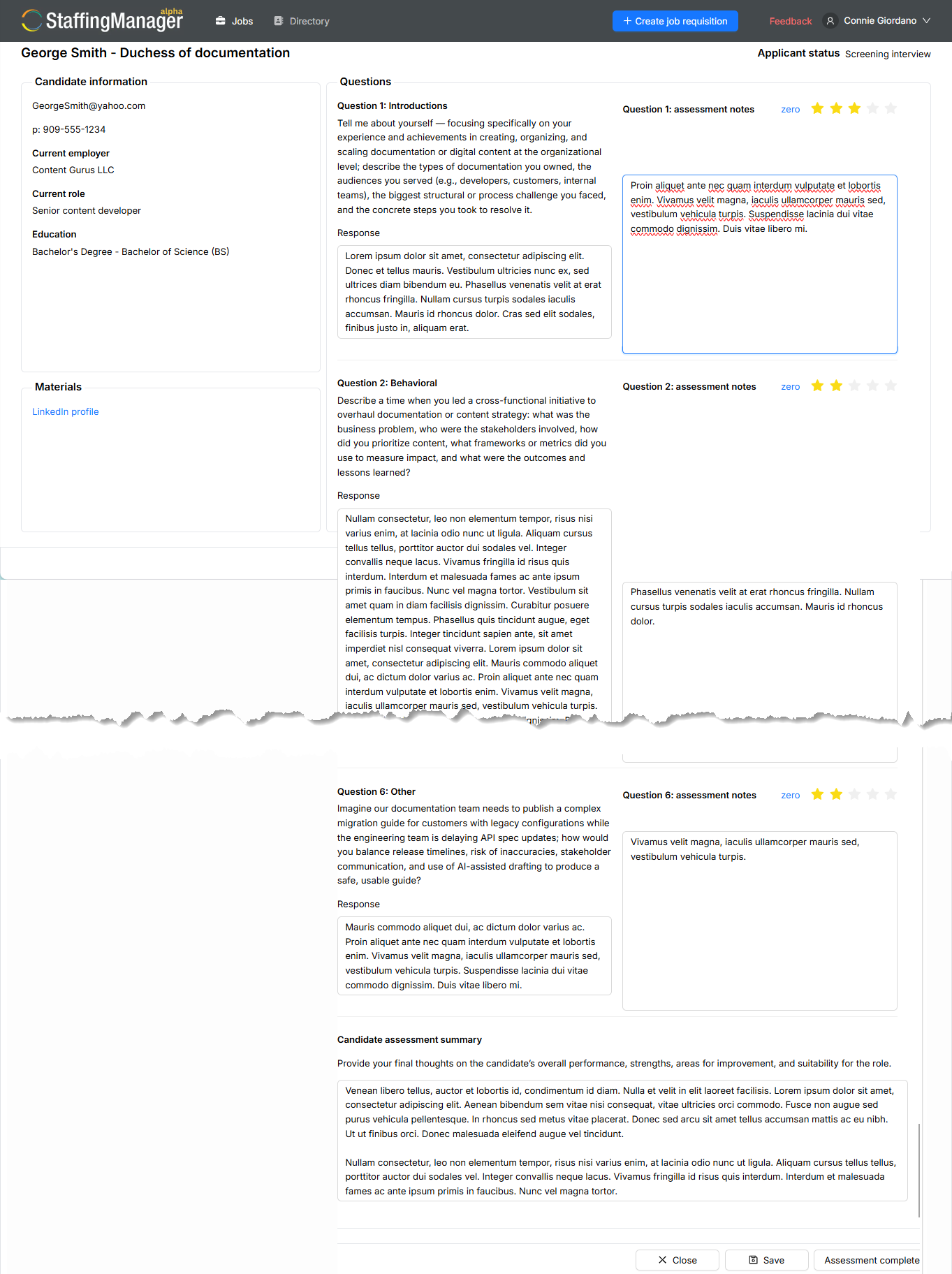
A few things that make this more useful later
-
Score right after the answer, not at the end of the interview. Details fade fast, and specific evidence beats a fuzzy overall impression.
-
Tie your note to the answer, not the person. “Gave a concrete example of reconciling a $300K variance, walked through root cause” is useful. “Seemed sharp” is not.
-
Watch for rating inflation. If everyone gets 4–5 stars, the scale stops telling you anything. Save the top of the scale for answers that genuinely stand out.
-
Use the same bar for every candidate. It's tempting to grade the third interview of the day more generously (or harshly) than the first — try to interrupt that instinct.
These per-question ratings are what roll up into the scores you'll see on the candidate list, so a little discipline here pays off later.